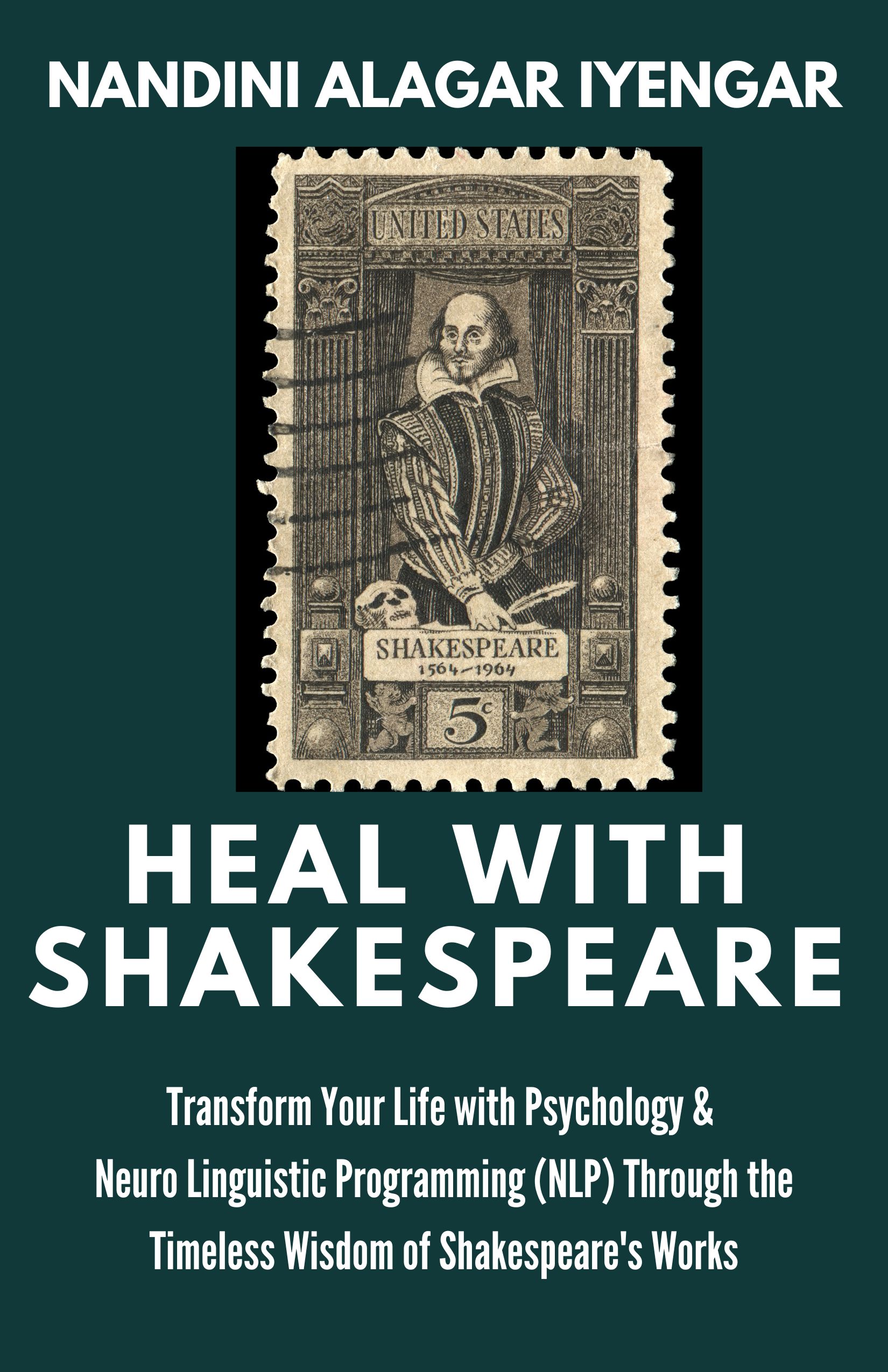
Heal with
Shakespeare
Timeless Wisdom for the Wounded, the Weary & the Seeking Soul
Four hundred years after Shakespeare put quill to parchment, his words still reach into the deepest chambers of the human heart — healing grief, awakening courage, restoring hope, and transforming pain into profound self-understanding.
The World's Greatest Playwright Is Also Its Greatest Healer
Long before therapy existed as a profession, Shakespeare was quietly doing what the best therapists do — holding a mirror up to human suffering, naming it with breathtaking precision, and in the very act of naming, beginning the process of healing. Heal with Shakespeare brings that ancient power into the hands of modern readers in a way that is deeply personal, immediately useful, and lastingly transformative.
Written by bestselling author Nandini A. Iyengar, this book is a guided journey through the healing landscape of Shakespeare's greatest works — exploring how his characters, his stories, his words, and his wisdom speak directly to the emotional crises, wounds, and longings of the contemporary human soul.
"We know what we are, but know not what we may be." — Hamlet, Act IV
From Hamlet's paralysing grief and Lear's shattering loss to Prospero's majestic forgiveness and Portia's radical mercy — every play in the Shakespearean canon is a masterclass in the full spectrum of human emotion. This book decodes those masterclasses and turns them into practical wisdom for healing, growing, and living more fully.
Order on Amazon →Six Profound Gifts from the Bard
-
✦
A Language for Your PainShakespeare names what we cannot. Finding your experience in his words is the first act of healing.
-
✦
Mirrors for Your EmotionsSee your grief, anger, love, fear, and resilience reflected in characters who have walked every human path before you.
-
✦
Frameworks for ForgivenessLearn how Shakespeare's greatest characters move through betrayal, loss, and injustice — and find the extraordinary freedom of letting go.
-
✦
Courage in the Face of UncertaintyPractical wisdom for navigating life's most destabilising moments — drawn from the plays that have outlasted every era of human crisis.
-
✦
A Path Through GriefFrom the raw anguish of loss to the quiet morning of renewal — Shakespeare charts the full grief journey with compassion and clarity.
-
✦
The Wisdom of Self-Knowledge"To thine own self be true" — not a cliché, but a complete philosophy of authentic living explored in its full, healing depth.
What's past is prologue.
The TempestThis above all: to thine own self be true.
HamletThe quality of mercy is not strained.
The Merchant of VeniceTwelve Plays, Twelve Pathways to Healing
Each play explored in Heal with Shakespeare opens a distinct doorway to emotional insight — addressing the universal human struggles that Shakespeare understood with uncanny depth.
Grief, Paralysis & the Will to Act
The world's most famous grieving son shows us how unprocessed loss becomes paralysis — and what it truly takes to move through the darkness toward decisive, meaningful action.
The Breaking Point That Becomes a Beginning
Lear's catastrophic unravelling mirrors every devastating loss of identity, status, and love — and reveals the profound wisdom that can only be born from total collapse.
Forgiveness as the Supreme Act of Freedom
Prospero's journey from revenge to mercy is one of literature's greatest healing arcs — a masterclass in how choosing forgiveness liberates the forgiver far more than the forgiven.
Jealousy, Trust & the Cost of Self-Deception
A devastating exploration of how insecurity and manipulated doubt destroy what love builds — and what it means to know and trust yourself before you can truly trust another.
Ambition, Guilt & the Path to Inner Peace
The wages of unexamined ambition and silenced conscience — and what Shakespeare's darkest tragedy teaches us about the soul's need for alignment between desire and integrity.
Chaos, Confusion & the Wisdom of Surrender
When the world stops making sense, the forest of confusion becomes the place of transformation. A joyful reminder that not all disorientation is disaster — sometimes it is the prelude to clarity.
Love, Loss & Learning to Grieve Beautifully
Beyond the romance lies one of the most profound meditations on the grief of love lost — and on how the heart's capacity to love deeply is itself the greatest act of courage.
Mercy, Justice & the Healing Power of Compassion
Portia's landmark speech on mercy is not merely a legal argument — it is a complete philosophy of compassionate living that remains as radical and necessary today as it was in 1600.
Wounded Pride, Wit & the Courage to Love Again
How sarcasm and defensiveness protect a wounded heart — and how two people who have been hurt by love must find the courage, beneath all their armour, to risk it again.
Exile, Resilience & Finding Home Within
Banished to the Forest of Arden, Shakespeare's characters discover that the external journey of exile is always also an internal journey — and that home is ultimately a state of the soul, not a location.
Jealousy's Destruction & the Miracle of Restoration
A play about the long arc of healing — sixteen years of loss, regret, and estrangement — culminating in a restoration so tender and miraculous it defies the logic of time.
Love, Time, Beauty & the Soul's Enduring Worth
154 poems that chart every dimension of the human heart's experience — from the ecstasy of new love to the anguish of betrayal, from the fear of ageing to the defiance of death through art and love.
Nine Emotional Territories Shakespeare Maps for You
Every human wound has its Shakespearean mirror. This book navigates nine of the most universal emotional landscapes — with the Bard as your compassionate, unflinching guide.
Healing Grief & Loss
From Hamlet's black garb to Lear's howl over Cordelia — Shakespeare gives grief its full, unfiltered expression, and in doing so, makes room for the grieving reader to breathe.
The Art of Forgiveness
Prospero. Hermione. Helena. Shakespeare's great forgivers show us that mercy is not weakness — it is the supreme act of inner sovereignty and self-liberation.
Anger Without Destruction
How to feel rage fully, express it honestly, and channel it toward transformation rather than devastation — lessons from Lear, Othello, and the fierce women of the comedies.
Self-Knowledge & Identity
"To thine own self be true" — unpacked in its full complexity. Who are you beneath the roles you play? Shakespeare's mirror is the most unflinching one in all of literature.
Resilience & Renewal
The green world of Shakespeare's comedies — exile, forest, sea, storm — is always the place of renewal. Disruption, the plays suggest, is often the soil in which new selfhood grows.
Love, Heartbreak & Healing
Every form of love — romantic, parental, platonic, self-love — explored with total honesty. Shakespeare never lies about love, which is exactly why his love stories heal us.
Justice, Betrayal & Peace
When we have been wronged — how do we seek justice without losing ourselves? How do we find peace when the world offers none? Shakespeare's problem plays offer radical, practical answers.
Fear, Anxiety & the Unknown
From the ghost of Hamlet's father to the witches of Macbeth — Shakespeare dramatises our deepest anxieties with unflinching honesty, and in naming the dark, helps us step through it.
Transformation & Transcendence
The final plays — The Tempest, The Winter's Tale, Cymbeline — are Shakespeare's most profound meditations on grace, second chances, and the human capacity for extraordinary renewal.
Eight Reasons This Book Will Change You
This is not a literary analysis. It is a healing companion. Every page is written not to impress you with scholarship — but to reach you where you are actually hurting, and to offer the Bard's timeless medicine exactly there.
No Shakespeare Background Required
The book is written to be fully accessible to readers who have never studied Shakespeare — and deeply enriching for those who have. The Bard's wisdom belongs to everyone.
Grounded in Real Emotional Psychology
Each chapter connects Shakespeare's insights to modern understanding of grief, trauma, resilience, and emotional wellbeing — making the ancient wisdom immediately practical.
Bibliotherapy at Its Most Profound
The therapeutic power of literature is well-documented. Shakespeare is its greatest practitioner. This book is the bridge between that power and your personal healing journey.
Reflection Prompts After Every Chapter
Each section closes with carefully crafted reflection questions that help you personalise the Shakespearean insight and apply it directly to your own emotional experience.
Written with Warmth, Not Academic Distance
This is not a textbook. It is a companion written by someone who has experienced Shakespeare's healing power personally — and wants to share that experience with you.
A Complete Emotional Wellness Framework
Together, the chapters form a complete map of the emotional healing journey — from acknowledging pain, through processing and understanding it, to renewal and self-reclamation.
Prose That Moves You as Much as the Plays
Written by an author with a postgraduate background in English Literature, every page honours the beauty of Shakespeare's language while making it sing for the contemporary reader.
Timeless — Yet Completely of Its Moment
Shakespeare wrote for a world in upheaval. So do we live in one. His prescriptions for psychological survival and spiritual flourishing are not dated — they are precisely what this moment demands.
Why Shakespeare Is the World's First Healer of the Human Soul
The question is sometimes asked: why Shakespeare? Why, in a world of modern psychology, mindfulness practices, self-help literature, and therapeutic innovation, should we turn to a playwright who has been dead for four centuries? The answer is disarmingly simple. Because no one — not before, not since — has understood the human heart as completely as William Shakespeare did. Not because he was superhuman, but because he was supremely, relentlessly, fearlessly human. He looked at everything the human soul is capable of — its soaring love and its murderous rage, its petty vanity and its transcendent mercy, its catastrophic self-deception and its moments of crystal-clear self-knowledge — and he rendered every single shade with a precision that leaves the reader feeling, not just seen, but known.
This is the essence of what bibliotherapy — the therapeutic use of literature — identifies as literature's healing mechanism. When we encounter in a text an emotion we have felt but never been able to name, something in the psyche releases. We are no longer alone with our pain. We are in the company of every human being who has felt it before us. And if Hamlet could survive his grief, if Lear could find lucidity after his shattering, if Prospero could choose mercy over vengeance, if the lovers of the comedies could find their way through the forest of confusion to the clearing of joy — then perhaps so can we.
The plays Shakespeare wrote are not merely entertainment or even art. They are, as the scholar Harold Bloom once noted, the secular scripture of the modern world. They contain within them a complete map of the human interior — every emotional landscape charted, every psychological pitfall named, every path through darkness illuminated, if not always to happiness, then always to the deeper wisdom that makes genuine happiness possible. This book is a guided expedition into that map, with a compass calibrated for the modern reader's specific emotional coordinates.
What makes Heal with Shakespeare distinctive is that it refuses to sentimentalise either Shakespeare or the healing process. It does not promise that reading Hamlet will cure your depression, or that the Tempest will resolve your anger issues by Tuesday. What it does promise — and delivers — is something more valuable: an expansion of the emotional vocabulary and the psychological imagination, so that whatever you are going through, you have a richer, more nuanced, more compassionate set of inner resources with which to navigate it. Shakespeare does not make problems disappear. He makes the people who carry problems larger, wiser, and more beautifully equipped for the carrying.
From the First Wound to the Final Flourishing
The book is structured as a conscious, progressive journey through the emotional healing arc — following the same path that Shakespeare's greatest characters walk, from darkness to light.
Stage 1 — Acknowledgement: Naming the Pain
Healing begins not with fixing, but with seeing. The first stage uses Shakespeare's most emotionally raw passages — from Hamlet, King Lear, and Othello — to help readers finally name what they have been feeling without adequate words. Naming is the first act of reclaiming.
Stage 2 — Understanding: The Story Behind the Wound
Every wound has a story. This stage explores the psychological and emotional roots of the pain — using Shakespeare's characters as mirrors that reveal our own hidden narratives, patterns, and beliefs about ourselves and the world.
Stage 3 — Processing: Moving Through, Not Around
Shakespeare never lets his characters bypass their pain — and neither should we. This stage provides tools for moving through grief, anger, fear, and shame rather than avoiding them — supported by the emotional intelligence of the comedies and tragedies alike.
Stage 4 — Transformation: The Green World
In Shakespeare's comedies, the forest — the green world outside the corrupt city — is where transformation happens. This stage explores how disruption, exile, and disorientation can become, when navigated with awareness, the landscape of the most profound personal growth.
Stage 5 — Integration & Renewal: The Return
The final stage — drawing from The Tempest, The Winter's Tale, and the great sonnets — explores how healed beings return to the world: wiser, more merciful, more fully themselves. Not the same person who was wounded. A new one, shaped by the journey. Ready to live more completely than before.
Hamlet & the Anatomy of Grief — Shakespeare's Most Complete Healing Text
Of all Shakespeare's works, Hamlet is perhaps the most deeply therapeutic — not despite its darkness, but because of it. The play opens with a young man in the acute phase of fresh grief, wearing black in a court that has already moved on to celebration, told by his own mother that his mourning is excessive, irrational, an affront to the natural order. Sound familiar? How many of us have been told — or have told ourselves — that our grief should already be over, that we should be functioning better by now, that our continued sorrow is a failure of character rather than an entirely human response to unbearable loss?
Shakespeare does not agree. In Hamlet, he gives grief all the space it needs. He allows Hamlet's sorrow to be messy, contradictory, sometimes selfish, sometimes paralyzing, sometimes brilliantly insightful — because that is exactly what genuine grief is. And in doing so, he validates every reader who has ever felt that their own grief was too much, too complicated, too raw for the world's patience. You are not too much. Your grief is not a problem. It is the price of having loved. Shakespeare knew that four hundred years ago, and his play is the most beautiful proof.
But Heal with Shakespeare goes further than simply validating grief. It uses Hamlet as a lens for understanding the specific psychological mechanisms of the grief process — including the way grief can masquerade as anger, the way it can generate profound philosophical insight even in the midst of pain, and the way its resolution — when it comes — is not a forgetting or a moving on, but an integration, a carrying-forward of love in a new form. This chapter alone has moved readers to tears of recognition — and then, remarkably, to a quiet, earned sense of peace.
The Tempest — Shakespeare's Final Word on Forgiveness & Freedom
Prospero's decision at the end of The Tempest — to release his enemies rather than destroy them, to choose mercy over the revenge he has spent the entire play orchestrating — is, in the opinion of many scholars, Shakespeare's most mature and hard-won wisdom. It is also, for many readers, the most personally challenging passage in all of literature. Because while it is relatively easy to understand forgiveness intellectually, it is a different matter entirely to choose it in the actual presence of the person or event that wounded you. Prospero knows this. He chooses mercy not because it is easy, but because he understands — at the deepest level — that continuing to hold onto his grievance would imprison him more completely than it ever imprisoned his enemies.
This chapter of Heal with Shakespeare works with Prospero's journey as a complete framework for the practice of forgiveness — exploring what forgiveness actually means (it does not mean excusing, forgetting, or reconciling), what it requires of us psychologically, and why Shakespeare presents it not as a spiritual obligation but as a pragmatic act of self-liberation. The freedom that Prospero receives at the play's end — "Now my charms are all o'erthrown, And what strength I have's mine own" — is the freedom that genuine forgiveness confers. It is the freedom to be fully, finally, unapologetically yourself again.
Who Will Find Healing in These Pages?
You do not need a degree in literature. You need only a willingness to be met — as you are, where you are — by one of the most compassionate voices the human world has ever produced.
- Anyone navigating grief, loss, or bereavement
- Those recovering from heartbreak, betrayal, or broken trust
- Readers seeking emotional healing through the power of literature
- Shakespeare enthusiasts longing for a deeper personal connection to the plays
- Therapists, counsellors & wellness professionals exploring bibliotherapy
- Students of English literature, psychology, or personal development
- Anyone working through anxiety, fear, or a loss of direction
- Lovers of books who believe stories have the power to heal
- Those processing anger, resentment, or the need to forgive
- Everyone who has ever felt that no one — and nothing — truly understood
Frequently Asked Questions

Nandini A. Iyengar
Author · Healer · Coach · Publisher
Nandini A. Iyengar is a postgraduate in both English Literature and Business Management — a rare combination that gives her work its distinctive quality: the literary intelligence to engage with Shakespeare at the deepest level, and the practical wisdom to translate that engagement into genuine personal transformation for her readers.
As the author of over 180 books spanning spirituality, self-help, AI, business leadership, and now literary healing — and as the founder of Sampoornam Publishers and Talent Canvas — Nandini brings to every book she writes the same quality that makes Shakespeare endure: a profound understanding of the human heart and an unshakeable commitment to truth.
Heal with Shakespeare is, in many ways, her most personal work — drawing on her own lifelong relationship with the Bard's words, her 20+ years as a mindfulness practitioner and transformational coach, and her deep conviction that the greatest literature the world has ever produced belongs not in academic footnotes but in the hands of every human being who is hurting and seeking a way through.
More Transformative Books
From ancient devotion to modern AI — each book a doorway to a richer, more purposeful life.



Explore Literary Healing & Emotional Wellness
Whether you are searching for Shakespeare self-help books, emotional healing through literature, bibliotherapy books, healing grief with books, Shakespeare quotes for healing, Shakespeare and mental health, literary wellness books, Shakespeare forgiveness, books for emotional resilience, healing with classic literature, Shakespeare for personal growth, inner transformation books, or Shakespeare wisdom for modern life — Heal with Shakespeare is the most comprehensive, compassionate, and practically transformative guide available.